
Research

Research and development of the lead Δ42PD1 antibody drug as an immunotherapy against cancers and infections

Leading the way to address unmet medical needs and contribute to global public health via revolutionizing cancer treatments


The primary objective of this project focuses on developing ​Δ42PD1-targeting therapy for cancers and infectious diseases. Specifically, the team aims to advance the lead Δ42PD1-blocking antibody candidate, huCH101, through transformational R&D into clinical trials. 1) Lead huCH101’s interaction and characterization. 2) Process development of huCH101 to refine culturing conditions, and establishing downstream purification processes, will be developed and optimised. 3) The huCH101 GMP product will undergo stringent quality testing to ensure it meets clinical evaluation standards. 4)The efficacy, pharmacokinetics/pharmacodynamics (PK/PD) properties, and toxicity of huCH101 will be determined in preclinical animal models to validate the antibody's effectiveness and safety. 5) Conduct a Phase 1 clinical trial to evaluate safety, tolerability, optimal dosage level and regimen of huCH101 in liver cancer patients. 6) Expressions of Δ42PD1 and other immune markers on immune cells will be assessed using clinical samples from patients with different cancer types or infectious diseases via flow-cytometric and transcriptomics analyses. This would expand the potential indications for the ∆42PD1-targeting therapy beyond liver cancer. 7) To gain comprehensive understanding of the Δ42PD1 signalling pathway and the action of huCH101 through mechanistic studies using models in vitro and in vivo, coupled with multi-omics analyses. Structural interaction of huCH101 with ∆42PD1 will be determined with cryogenic electron microscopy to provide structural insights of the mechanism of action of huCH101. 8) New therapeutics targeting Δ42PD1 pathway will be generated and examined including new interactor identification. This also includes refining huCH101 to enhance affinity and experimenting with anti-Δ42PD1 bispecific antibodies in preclinical models established above. 9) Leveraging Δ42PD1 as a biomarker, a diagnostic/prognostic system will be developed. Δ42PD1-specific antibodies and cutting-edge detection technologies, including digital PCR, will be examined as potential detection assays. This could ultimately improve diagnostic precision and personalize treatment plans. In summary, this project aims to deliver an effective Δ42PD1-targeting therapy for liver cancer through the strategic roadmap outlined above.


Translation Preclinical R&D and Evaluation of the Therapeutic Anti-dellta42PD1 huCH101 candidate

Exploratory Clinical Characterisation of huCH101 candidate for Liver Cancer

R&D on New Cancer or Infectious Diseases Indication and Next Generation delta42PD1-Targeting Therapy

Clinical Development and Evaluation of the huCH101 candidate for Cancer or Infectious Diseases

delta42PD1-based Biomarker Diagnostic/ Prognostic System


Although immune checkpoint inhibitors’ (ICI’s) market size reaches US$49.5 billion in 2023, the ICI’s low response rate of ~20% among patients with liver cancer (hepatocellular carcinoma, HCC) and solid tumors calls for new anti-HCC immunotherapeutics with distinct targets.


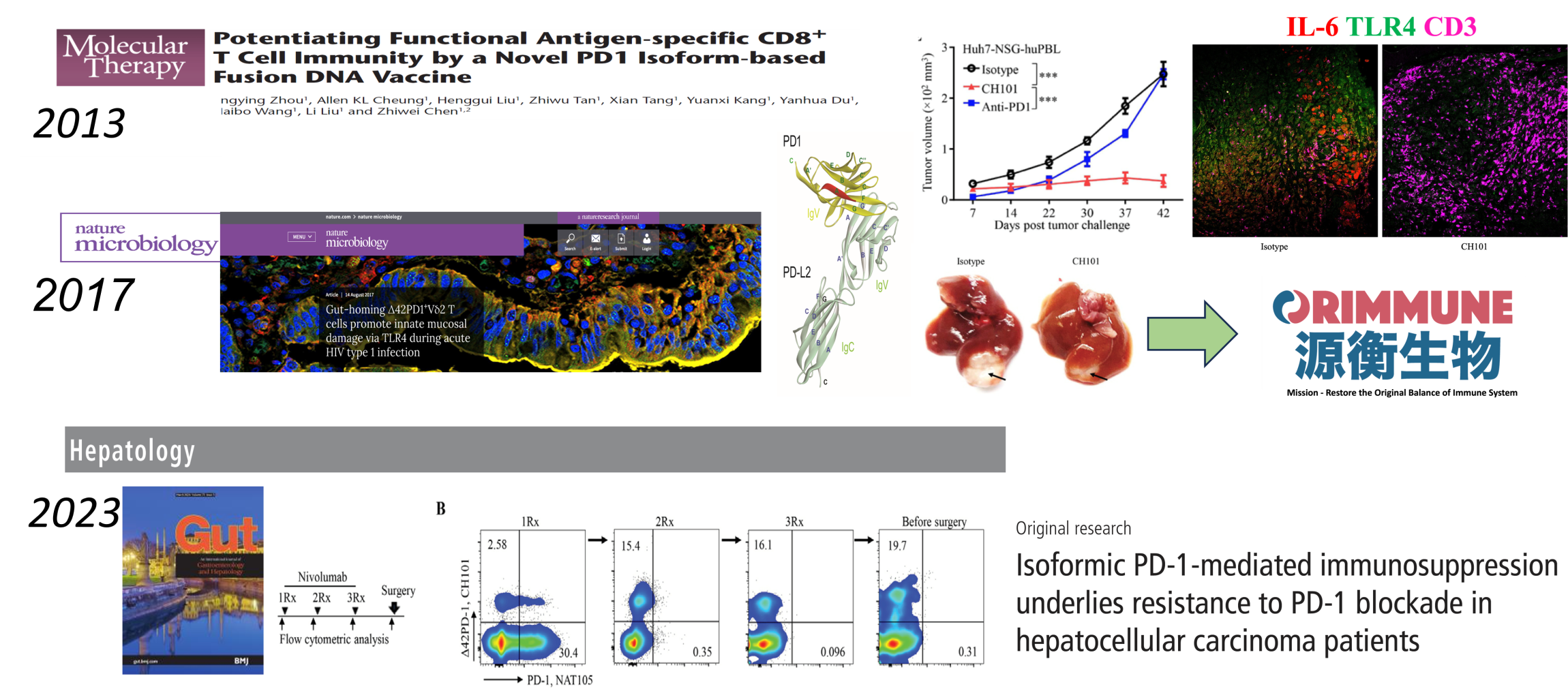
Prof Zhiwei CHEN and the HKU team have made innovative advancements in the field of immunotherapy, identifying a novel drug target called Δ42PD1 with distinct immune-modulatory function. Δ42PD1 exhibits a completely different mechanism from the canonical PD-1: instead of interacting with normal PD-1 ligands, Δ42PD1 acts with toll-like receptor 4 pathway to trigger pro-inflammatory response. The team has demonstrated the role of Δ42PD1 in promoting mucosal pathogenesis during acute HIV-1 infection (Nature Microbiology 2017) and liver cancer growth (Gut 2023) using preclinical models and clinical samples, laying the foundation for exploring the innovative Δ42PD1-targeting immunotherapy. The HKU team has generated Δ42PD1-blocking antibodies with immunotherapeutic potential. Two relevant international patents were granted to HKU. To propel the translational R&D, Immuno Cure has contributed a contract research project with the HKU team and was granted two global exclusive licenses by HKU to develop Δ42PD1-blocking antibodies for clinical use. This long-term collaboration has resulted in a first-in-class Δ42PD1-blocking antibody drug for next-stage transformational R&D. 
To facilitate the clinical development and commercialisation of Δ42PD1-targeting immunotherapies, the HKU Team, in collaboration with Industry Partner, has established Orimmune BioTech Limited. This start-up aims to sub-license the IP's from Industry Partner to develop and market the immunotherapies against cancers and infectious diseases by leveraging the discoveries and intellectual properties associated with Δ42PD1. The primary objective of this RAISe+ project is the transformational R&D on the Δ42PD1 pathway, with the goal of advancing the lead Δ42PD1-blocking antibody drug into clinical trials against liver cancer as the first step, and against other Δ42PD1-associated cancers and infections as the second step. 

Public Photos / Files - immunotherpy